
Diversity
The family Eleotridae contains about 35 genera and 150 species, and of these most
are found in the tropical Indo-Pacific. They are commonly known as sleepers, or gudgeons
in Australia and New Guinea, and in New Zealand they are called bullies. The family
is similar to
Gobiidae
but generally lacks the pelvic fin fusion that creates a “sucking disc” in gobies.
The majority of eleotrids lives in brackish or fresh water. Only a few species are
truly marine, but many fresh water species have a marine larval stage and return inland
as juveniles. They are carnivorous, and in turn are eaten by humans in many parts
of their range. Sixteen species of eleotrids are listed as near threatened or vulnerable
to extinction.
Geographic Range
Eleotrids can be found worldwide between the 40th parallels (tropical and subtropical
regions), reaching farther south in New Zealand. They occur on five continents and
are common in the islands of the Indo-Pacific.
- Biogeographic Regions
- nearctic
- palearctic
- oriental
- ethiopian
- neotropical
- australian
- oceanic islands
- indian ocean
- pacific ocean
- mediterranean sea
- Other Geographic Terms
- island endemic
Habitat
Eleotrids occupy mostly fresh and brackish water. While only a few species are marine,
many freshwater eleotrids spend their larval stage in the ocean and return inland
as juveniles. They live in tropical and subtropical areas, and a few occur in warm
temperate waters. They are common residents of mangrove and other estuarine environments.
Eleotrids can be found near rocky reefs in bays, in intertidal areas, and in streams
or ponds. Some prefer still water among aquatic vegetation. Many live on muddy substrates
(bottoms)—most eleotrids are benthic (bottom-dwelling)—but a few are free-swimming.
- Habitat Regions
- temperate
- tropical
- saltwater or marine
- freshwater
- Aquatic Biomes
- benthic
- reef
- lakes and ponds
- rivers and streams
- coastal
- brackish water
- Other Habitat Features
- estuarine
- intertidal or littoral
Systematic and Taxonomic History
The family Eleotridae contains about 35 genera and 150 species. Some estimates range
as high as 300 species. The variability in estimates may be due in part to lack of
clarity about where to place members of the family; eleotrids are very similar to
gobies. Hoese and Gill (1993) created the family
Odontobutidae
and placed in it three genera formerly contained in Eleotridae (Nelson 1994). Some
forms are still undescribed.
Physical Description
Eleotrids are small, most measuring between three and 20 cm, although one species,
Oxyeleotris marmorata
, reaches 66 cm. They are similar to members of the family
Gobiidae
, with similar head shape, an elongate body, no lateral line, and two separate dorsal
fins. They are generally distinguished from
Gobiidae
on the basis of their separated pelvic fins that do not form a sucking disc. The
degree of pelvic fin separation varies, however, and cannot reliably be the only characteristic
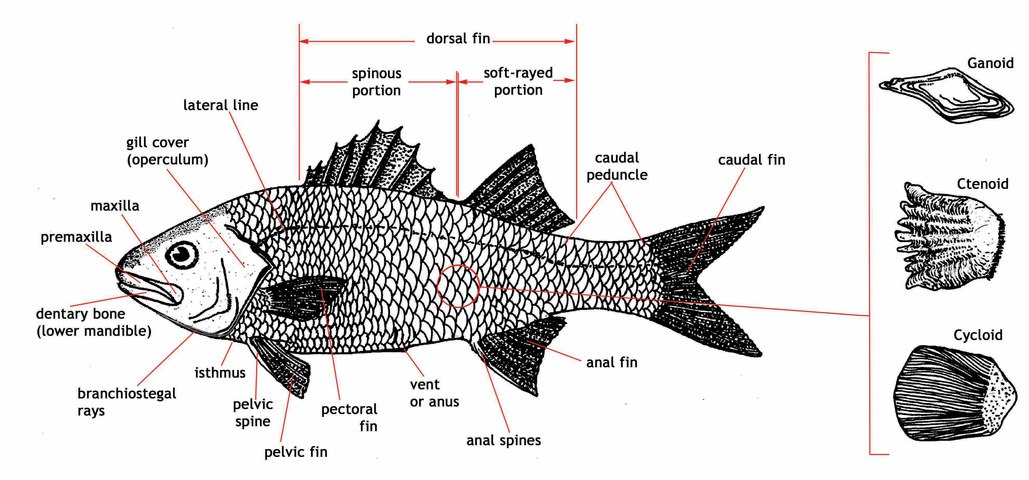
used to identify eleotrids. Eleotrids can have cycloid or ctenoid (rough-edged)
scales
. They lack sensory pores, and have canals only on the head. Their mouths, filled
with several rows of conical teeth, can be upturned or terminal, but never inferior.
The first dorsal fin contains two to eight flexible spines, and a single spine heads
the second. Many eleotrids have a well-developed swim bladder, although they are generally
benthic (bottom-dwelling). Some have dull, brownish or dark coloration, while others
are colorful. One species that lives in wells and sinkholes,
Milyeringa veritas
, is white or pinkish and has no eyes. Some eleotrids may be permanently sexually
monomorphic (males and females alike), as is the case with most reef-dwelling gobies,
but males of some species develop distinctive coloring for courtship, or when excited
by the presence of a competitive male. During the breeding season a hump on the head
behind the eyes appears on males in the species
Hypseleotris galii
. (Click here to see a
fish diagram
).
- Other Physical Features
- ectothermic
- bilateral symmetry
- Sexual Dimorphism
- sexes alike
- male larger
- sexes colored or patterned differently
- ornamentation
Development
Many freshwater eleotrids are amphidromous: after hatching they float downstream to
brackish or marine waters where they pass through a planktonic larval stage, growing
and feeding for a few months before they migrate back to fresh water as juveniles.
This marine stage is thought to indicate that Eleotridae originated as a marine family.
Some freshwater gobies develop without a planktonic larval stage, becoming a benthic
juvenile directly after hatching, and this may be the case for some eleotrids as well.
Reproduction
No information was found that addresses mating systems specifically in eleotrids,
but Thresher (1984) includes Eleotridae in his general account of reproduction in
the suborder
Gobioidei
. Gobies exhibit a wide variety of mating systems but most seem to be promiscuous,
either organized into a hierarchical social system or small territories maintained
by individuals. At least one species of eleotrid (
Thalasseleotris adela
) is usually found in pairs. In gobies, a typical mating sequence begins with nest
preparation by the male, which involves clearing and cleaning the area where eggs
will be deposited. The female’s readiness for spawning is evidenced by her swollen
ventral area. The male swims back and forth between the female and the nest site and
in some cases he will nudge her with his snout. Eleotrid courtship behavior probably
follows a similar pattern, with some males assuming intense courtship colors and leading
females to the nest.
- Mating System
- monogamous
- polygynous
- polygynandrous (promiscuous)
Eleotrids attach their eggs to vegetation or a substrate (bottom surface). Females
in
Hypseleotris compressa
deposit up to 3000 eggs. No other information was found that addresses reproduction
specifically in eleotrids, but Thresher (1984) includes Eleotridae in his general
account of reproduction in the suborder
Gobioidei
. Most gobies have extended spawning seasons with peak spawning depending on the species,
but in colder regions breeding may only occur once or twice a year. Females may deposit
from five to several hundred eggs, which the male then fertilizes. In estuarine species
the lunar cycle is thought to play a role in spawning behavior as well as larval recruitment.
- Key Reproductive Features
- iteroparous
- seasonal breeding
- gonochoric/gonochoristic/dioecious (sexes separate)
- sexual
- fertilization
- oviparous
Males in
Hypseleotris compressa
guard the nest. No other information was found that addresses parental care specifically
in eleotrids, but Thresher (1984) includes Eleotridae in his general account of reproduction
in the suborder
Gobioidei
. In most cases, male gobies guard the eggs after they are fertilized, and even if
females are permanently paired they rarely take part in parental care. The young probably
stay close to adults for a period of time after hatching. In some freshwater island
species parental care is not practiced at all. Many eleotrids may fall into this category,
since the larvae are carried downstream to the ocean where they feed and grow before
ascending the freshwater streams.
- Parental Investment
- no parental involvement
- male parental care
Lifespan/Longevity
No information was found regarding the lifespan in Eleotridae. However, some small
gobies (similar in many respects to eleotrids) may mature quickly and live only one
or two years.
Behavior
Eleotrids earned their common name, “sleeper,” for their habit of remaining still
on the bottom or positioned near an object in the water while they wait for prey.
When chasing prey, however, they can perform very quick movements. Some, such as
Hypseleotris klunzingeri
, form dense schools in midwater. Many eleotrids occupy habitats that can become low
in oxygen (hypoxic), and some can breathe air through the skin on the front of the
head. When
Dormitator latifrons
encounters hypoxic waters, oxygen begins to fill the gas bladder and the top surface
of the head begins to fill with a thick bed of capillaries. In order to attain positive
buoyancy and keep the head exposed to air, the gas bladder must fill completely, but
this may take up to six hours. Until the gas bladder fully inflates, these fish use
submerged objects to prop themselves up. The top of the head does not become fully
vascularized for 10 to 20 days.
- Key Behaviors
- natatorial
- motile
- social
Communication and Perception
Eleotrids (except, presumably, for one eyeless species,
Milyeringa veritas
) recognize food and potential mates by sight. During breeding season males of some
species change color, providing a visual message to potential mates and competitors.
Other modes of communication likely exist, but no information was found regarding
these or non-visual perception channels.
- Communication Channels
- visual
Food Habits
Eleotrids are carnivores that feed on crustaceans and other benthic invertebrates,
small fishes, and insects. Many species pass through a marine larval stage during
which they feed on plankton.
- Primary Diet
-
carnivore
- piscivore
- insectivore
- eats non-insect arthropods
Predation
Some eleotrids have dull coloring that may help them hide from predators, and some
form dense schools, which protect individual fishes from predation.
- Anti-predator Adaptations
- cryptic
Ecosystem Roles
Often the major predators in island stream systems, eleotrids form an important element
of the freshwater fauna in the regions in which they are found. Many impact not only
the crustaceans, fishes, and insects on which they feed as adults, but also join the
marine planktonic ecosystem as larvae. Eleotrids are able to occupy various habitats,
including brackish and hypoxic (low-oxygen) areas.
Economic Importance for Humans: Positive
Eleotrids are used for food in many regions. The freshwater species
Dormitator maculates
(
fat sleeper
) is considered a delicacy in Thailand, Sumatra, Borneo, and the Malay Peninsula.
Eleotrids are easy to breed in captivity and are used as aquarium fish.
Economic Importance for Humans: Negative
No specific information was found concerning any negative impacts to humans.
Conservation Status
Based on information gathered in 1994, 16 species within Eleotridae are near threatened
or vulnerable. Their populations are either small in terms of adult individuals or
in terms of total area in which they are found, rendering them vulnerable to human
exploitation, pollution, hybridization, competitors, parasites, or disease.
Additional Links
Contributors
Monica Weinheimer (author), Animal Diversity Web.
R. Jamil Jonna (author), Animal Diversity Web.
- Nearctic
-
living in the Nearctic biogeographic province, the northern part of the New World. This includes Greenland, the Canadian Arctic islands, and all of the North American as far south as the highlands of central Mexico.

- native range
-
the area in which the animal is naturally found, the region in which it is endemic.
- Palearctic
-
living in the northern part of the Old World. In otherwords, Europe and Asia and northern Africa.
- native range
-
the area in which the animal is naturally found, the region in which it is endemic.
- oriental
-
found in the oriental region of the world. In other words, India and southeast Asia.
- native range
-
the area in which the animal is naturally found, the region in which it is endemic.
- Ethiopian
-
living in sub-Saharan Africa (south of 30 degrees north) and Madagascar.
- native range
-
the area in which the animal is naturally found, the region in which it is endemic.
- Neotropical
-
living in the southern part of the New World. In other words, Central and South America.
- native range
-
the area in which the animal is naturally found, the region in which it is endemic.
- Australian
-
Living in Australia, New Zealand, Tasmania, New Guinea and associated islands.
- native range
-
the area in which the animal is naturally found, the region in which it is endemic.
- oceanic islands
-
islands that are not part of continental shelf areas, they are not, and have never been, connected to a continental land mass, most typically these are volcanic islands.
- native range
-
the area in which the animal is naturally found, the region in which it is endemic.
- native range
-
the area in which the animal is naturally found, the region in which it is endemic.
- Pacific Ocean
-
body of water between the southern ocean (above 60 degrees south latitude), Australia, Asia, and the western hemisphere. This is the world's largest ocean, covering about 28% of the world's surface.
- native range
-
the area in which the animal is naturally found, the region in which it is endemic.
- native range
-
the area in which the animal is naturally found, the region in which it is endemic.
- island endemic
-
animals that live only on an island or set of islands.
- temperate
-
that region of the Earth between 23.5 degrees North and 60 degrees North (between the Tropic of Cancer and the Arctic Circle) and between 23.5 degrees South and 60 degrees South (between the Tropic of Capricorn and the Antarctic Circle).
- tropical
-
the region of the earth that surrounds the equator, from 23.5 degrees north to 23.5 degrees south.
- saltwater or marine
-
mainly lives in oceans, seas, or other bodies of salt water.
- freshwater
-
mainly lives in water that is not salty.
- benthic
-
Referring to an animal that lives on or near the bottom of a body of water. Also an aquatic biome consisting of the ocean bottom below the pelagic and coastal zones. Bottom habitats in the very deepest oceans (below 9000 m) are sometimes referred to as the abyssal zone. see also oceanic vent.
- reef
-
structure produced by the calcium carbonate skeletons of coral polyps (Class Anthozoa). Coral reefs are found in warm, shallow oceans with low nutrient availability. They form the basis for rich communities of other invertebrates, plants, fish, and protists. The polyps live only on the reef surface. Because they depend on symbiotic photosynthetic algae, zooxanthellae, they cannot live where light does not penetrate.
- coastal
-
the nearshore aquatic habitats near a coast, or shoreline.
- brackish water
-
areas with salty water, usually in coastal marshes and estuaries.
- estuarine
-
an area where a freshwater river meets the ocean and tidal influences result in fluctuations in salinity.
- intertidal or littoral
-
the area of shoreline influenced mainly by the tides, between the highest and lowest reaches of the tide. An aquatic habitat.
- ectothermic
-
animals which must use heat acquired from the environment and behavioral adaptations to regulate body temperature
- bilateral symmetry
-
having body symmetry such that the animal can be divided in one plane into two mirror-image halves. Animals with bilateral symmetry have dorsal and ventral sides, as well as anterior and posterior ends. Synapomorphy of the Bilateria.
- sexual ornamentation
-
one of the sexes (usually males) has special physical structures used in courting the other sex or fighting the same sex. For example: antlers, elongated tails, special spurs.
- monogamous
-
Having one mate at a time.
- polygynous
-
having more than one female as a mate at one time
- polygynandrous
-
the kind of polygamy in which a female pairs with several males, each of which also pairs with several different females.
- iteroparous
-
offspring are produced in more than one group (litters, clutches, etc.) and across multiple seasons (or other periods hospitable to reproduction). Iteroparous animals must, by definition, survive over multiple seasons (or periodic condition changes).
- seasonal breeding
-
breeding is confined to a particular season
- sexual
-
reproduction that includes combining the genetic contribution of two individuals, a male and a female
- fertilization
-
union of egg and spermatozoan
- external fertilization
-
fertilization takes place outside the female's body
- oviparous
-
reproduction in which eggs are released by the female; development of offspring occurs outside the mother's body.
- male parental care
-
parental care is carried out by males
- natatorial
-
specialized for swimming
- motile
-
having the capacity to move from one place to another.
- social
-
associates with others of its species; forms social groups.
- visual
-
uses sight to communicate
- visual
-
uses sight to communicate
- tactile
-
uses touch to communicate
- chemical
-
uses smells or other chemicals to communicate
- cryptic
-
having markings, coloration, shapes, or other features that cause an animal to be camouflaged in its natural environment; being difficult to see or otherwise detect.
- pet trade
-
the business of buying and selling animals for people to keep in their homes as pets.
- food
-
A substance that provides both nutrients and energy to a living thing.
- carnivore
-
an animal that mainly eats meat
- piscivore
-
an animal that mainly eats fish
- insectivore
-
An animal that eats mainly insects or spiders.
References
Allen, G., D. Robertson. 1994. Fishes of the Tropical Eastern Pacific . Honolulu, HI: University of Hawaii Press.
Berra, T. 2001. Freshwater Fish Distribution . San Diego, CA: Academic Press.
Böhlke, J., C. Chaplin. 1968. Fishes of the Bahamas and Adjacent Tropical Waters . Wynnewood, PA: Published for the Academy of Natural Sciences of Philadelphia by Livingston.
Graham, J. 1997. Air-Breathing Fishes: Evolution, Diversity, and Adaptation. . San Diego, CA: Academic Press.
Helfman, G., B. Collete, D. Facey. 1997. The Diversity of Fishes . Malden, MA: Blackwell.
Kuiter, R. 1993. Coastal Fishes of South-Eastern Australia . Honolulu, HI: University of Hawaii Press.
Moyle, P., J. Cech. 2000. Fishes: An introduction to ichthyology – fourth edition . Upper Saddle River, NJ: Prentice-Hall.
Nelson, J. 1994. Fishes of the World – third edition . New York, NY: John Wiley and Sons.
The World Conservation Union, 2002. "IUCN 2002" (On-line). 2002 IUCN Red List of Threatened Species. Accessed August 23, 2003 at http://www.iucnredlist.org/ .
Thresher, R. 1984. Reproduction in reef fishes . Neptune City, NJ: T.F.H. Publications.
Wheeler, A. 1985. The World Encyclopedia of Fishes . London: Macdonald.