
Diversity
The subfamily Myospalacinae, the zokors, is an Old World group of fossorial
muroid
rodents. There are six species belonging to two genera in this subfamily,
Myospalax
and
Eospalax
.
Geographic Range
Myospalacines are distributed throughout China and southern Siberia.
- Biogeographic Regions
- palearctic
Habitat
Myospalacines are found in woodlands, steppes, river valley meadows, pastures, old
agricultural fields, and vegetable gardens. They are most common at elevations between
900 and 2,120 meters.
- Habitat Regions
- temperate
- terrestrial
- Terrestrial Biomes
- savanna or grassland
- forest
- Other Habitat Features
- agricultural
- riparian
Physical Description
Myospalacines have long, cylindrical bodies. They have soft, thick, gray to buff-colored fur, with a smattering of short vibrissae on the head. The body's ventral surface is usually paler than the dorsal surface. The tail is short; head and body length ranges from 147 to 270 mm and tail length ranges from 29 to 96 mm. Zokors weigh between 150 and 563 grams. The eyes are tiny and covered by fur and there are no external ears. The limbs are short, but the feet are very wide and strong, with curved claws. The third claw on each forefoot is the strongest, whereas the 1st and 5th digits are reduced. The longest claws on the forefeet are at least three times the length of the claws on the hindfeet.
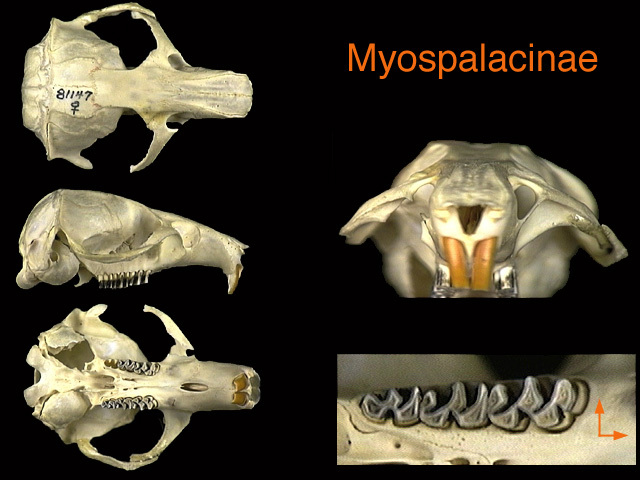
The myospalacine dental formula is 1/1, 0/0, 0/0, 3/3 = 16. The
incisors
are orthodont, and the
molars
are
hypsodont
and
omegaform
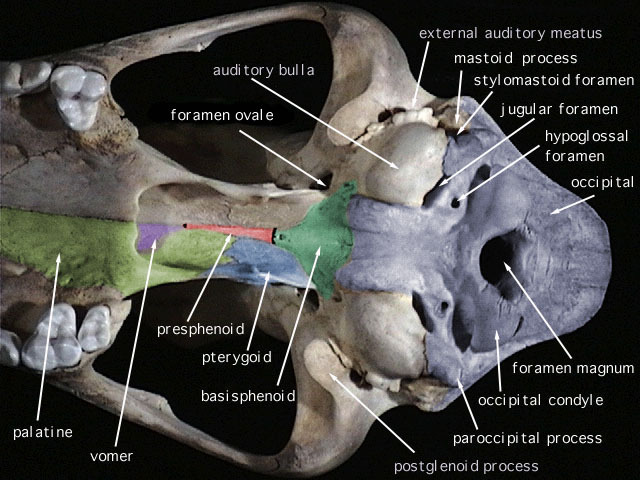
. Myospalacines have
tympanic bullae
that are somewhat inflated and their
mallei
are perpendicular in conformation. They have fused cervical vertebrae, stomachs
composed of three parts, and 16-chambered ceca. There are three pairs of mammae.
Myospalacines have a diploid number of chromosomes between 44 and 64.
- Other Physical Features
- endothermic
- homoiothermic
- bilateral symmetry
Reproduction
No information is available on the mating system of myospalacines.
A female myospalacine gives birth once each spring to a litter of four to five young.
The young stay with their mother throughout the spring and summer, dispersing in autumn.
- Key Reproductive Features
- iteroparous
- seasonal breeding
- gonochoric/gonochoristic/dioecious (sexes separate)
- sexual
- viviparous
Little information is available on the investment that zokors make in their offspring.
Female zokors nurse their young, as do all mammals, and the young associate with their
mother for several months after they are born.
- Parental Investment
-
pre-fertilization
- provisioning
-
protecting
- female
-
pre-hatching/birth
-
provisioning
- female
-
protecting
- female
-
provisioning
-
pre-weaning/fledging
-
provisioning
- female
-
provisioning
Lifespan/Longevity
The lifespan of myospalacines has not been reported.
Behavior
Myospalacines spend almost all of their time below ground, burrowing about through
the soil. They dig with their forefeet and push out soil with their heads. If forced
to walk above ground, they curve their long foreclaws down under their feet and walk
on top of them. Each zokor constructs a burrow system consisting of a nest chamber,
storage chamger, and defecation chamber about two meters below the surface, with one
to four shallower foraging tunnels radiating outward. These foraging tunnels may
be up to 100 meters long. When zokors dig, they push loose earth out of their tunnels
and onto the soil surface, leaving a series of dirt mounds in their wake. Zokors
occasionally forage above ground at night. They are active throughout the year, but
their activity peaks in the spring and the fall. Zokors are mainly solitary, and
can be highly aggressive and territorial.
- Key Behaviors
- terricolous
- fossorial
- motile
- sedentary
- solitary
- territorial
Communication and Perception
Zokors have keen senses of smell and hearing. Their eyes, although small, are sensitive
to light. They communicate with one another by scent-marking with their urine and
feces. They also have particular calls they use when threatening or attacking other
individuals, and they give an alarm squeal when threatened by predators.
- Other Communication Modes
- scent marks
Food Habits
Myospalacines are primarily herbivores. Bulbs, roots, grains, and rhizomes make up
the bulk of the zokor diet, but they also eat leaves and shoots, and occasionally,
insects and other arthropods. Zokors dig underground storage chambers where they
keep surplus plant foods for future consumption.
- Foraging Behavior
- stores or caches food
Predation
Many species of mammalian
carnivores
,
hawks, eagles
, and
owls
prey upon zokors. A few of the species that include zokors in their diet are: steppe
polecats (
Mustela eversmannii
), Eurasian ferrets (
Mustela nigripes
), Chinese mountain cats (
Felis bieti
), Pallas’s cat (
Otocolobus manul
), Eurasian lynx (
Lynx lynx
), foxes (
Vulpes ferrilata
and
V. vulpes
), golden eagles (
Aquila chrysaetos
), upland buzzards (
Buteo hemilasius
), saker falcons (
Falco cherrug
), goshawks (
Accipiter gentilis
), black kites (
Milvus migrans
), and little owls (
Athene noctua
). Zokors probably avoid much predation by spending most of their time underground
and only coming above ground to forage at night.
Ecosystem Roles
Zokors may increase plant diversity and change the competitive interactions among
plants in the short term by creating a heterogeneous distribution of nutrients when
they deposit soil on the ground surface. They also may aerate soil and allow water
to reach plant roots more easily. However, in the long run, they have been shown
to decrease the biomass of certain types of plants and thus lower the plant species
diversity overall. They negatively impact plant growth not only by consuming plants
but through their burrowing activity, which disturbs or destroys plant roots. An
indirect benefit of zokors is that they avoid eating plants that contain secondary
chemical compounds, so those plants tend to become dominant and prevent livestock
from overgrazing. The activities of zokors affect other animals, too. Many species
of birds, mammals, reptiles, and amphibians seek refuge and breed in zokor burrows.
Zokors compete with other small mammals for space. And finally, a range of predatory
mammals and birds, as well as a number of parasites (including nematodes, fleas, ticks,
and mites), depend on zokors as a food source.
- Ecosystem Impact
- creates habitat
- soil aeration
- fleas ( Siphonaptera )
- Ctenophthalmus dilatatus
- Rhadinopsylla ioffi
- Brachyctenonotus myospalacis
- ixodid ticks ( Ixodidae )
- Ixodes crenulatus
- Ixodes persulcatus
- gamasid mites ( Gamasida )
- Hirstionyssus myosplalacis
- nematodes ( Nematoda )
- Ascarops strongylina
Economic Importance for Humans: Positive
Since the 1970s, zokor bones have been used in place of tiger bones in traditional
Chinese medicine.
- Positive Impacts
- source of medicine or drug
Economic Importance for Humans: Negative
When present in large numbers, zokors can become serious agricultural pests, destroying
crops, competing with cattle for browse, and causing soil erosion. For these reasons,
intensive poisoning campaigns have been carried out by local governments in China
since the 1980s.
- Negative Impacts
- crop pest
Conservation Status
The IUCN lists three myospalacine species as lower risk (
Myospalax epsilanus
,
M. rothschildi
,
M. smithii
), and one as vulnerable (
M. fontanierii
). Eradication campaigns and harvesting of zokors for their bones have taken their
toll on zokor populations. Recently, scientists have acknowledged that "pest" species
such as zokors only become problematic when rangeland is overgrazed, and they recognize
that native wildlife is essential for preserving a balanced ecosystem. Therefore,
comprehensive rangeland management plans that seek to preserve the natural equilibrium
and do away with the widespread practice of killing zokors have now been adopted by
landowners throughout western China.
Other Comments
The earliest known myospalacine fossils, belonging to an extinct genus, date to the
middle Miocene in Mongolia.
Myospalax
fossils from the Pleistocene are the earliest representives of the living myospalacine
genera.
Additional Links
Contributors
Tanya Dewey (editor), Animal Diversity Web.
Allison Poor (author), University of Michigan-Ann Arbor.
- Palearctic
-
living in the northern part of the Old World. In otherwords, Europe and Asia and northern Africa.

- native range
-
the area in which the animal is naturally found, the region in which it is endemic.
- temperate
-
that region of the Earth between 23.5 degrees North and 60 degrees North (between the Tropic of Cancer and the Arctic Circle) and between 23.5 degrees South and 60 degrees South (between the Tropic of Capricorn and the Antarctic Circle).
- terrestrial
-
Living on the ground.
- tropical savanna and grassland
-
A terrestrial biome. Savannas are grasslands with scattered individual trees that do not form a closed canopy. Extensive savannas are found in parts of subtropical and tropical Africa and South America, and in Australia.
- savanna
-
A grassland with scattered trees or scattered clumps of trees, a type of community intermediate between grassland and forest. See also Tropical savanna and grassland biome.
- temperate grassland
-
A terrestrial biome found in temperate latitudes (>23.5° N or S latitude). Vegetation is made up mostly of grasses, the height and species diversity of which depend largely on the amount of moisture available. Fire and grazing are important in the long-term maintenance of grasslands.
- forest
-
forest biomes are dominated by trees, otherwise forest biomes can vary widely in amount of precipitation and seasonality.
- agricultural
-
living in landscapes dominated by human agriculture.
- riparian
-
Referring to something living or located adjacent to a waterbody (usually, but not always, a river or stream).
- endothermic
-
animals that use metabolically generated heat to regulate body temperature independently of ambient temperature. Endothermy is a synapomorphy of the Mammalia, although it may have arisen in a (now extinct) synapsid ancestor; the fossil record does not distinguish these possibilities. Convergent in birds.
- bilateral symmetry
-
having body symmetry such that the animal can be divided in one plane into two mirror-image halves. Animals with bilateral symmetry have dorsal and ventral sides, as well as anterior and posterior ends. Synapomorphy of the Bilateria.
- iteroparous
-
offspring are produced in more than one group (litters, clutches, etc.) and across multiple seasons (or other periods hospitable to reproduction). Iteroparous animals must, by definition, survive over multiple seasons (or periodic condition changes).
- seasonal breeding
-
breeding is confined to a particular season
- sexual
-
reproduction that includes combining the genetic contribution of two individuals, a male and a female
- viviparous
-
reproduction in which fertilization and development take place within the female body and the developing embryo derives nourishment from the female.
- fossorial
-
Referring to a burrowing life-style or behavior, specialized for digging or burrowing.
- motile
-
having the capacity to move from one place to another.
- sedentary
-
remains in the same area
- solitary
-
lives alone
- territorial
-
defends an area within the home range, occupied by a single animals or group of animals of the same species and held through overt defense, display, or advertisement
- acoustic
-
uses sound to communicate
- chemical
-
uses smells or other chemicals to communicate
- scent marks
-
communicates by producing scents from special gland(s) and placing them on a surface whether others can smell or taste them
- visual
-
uses sight to communicate
- tactile
-
uses touch to communicate
- acoustic
-
uses sound to communicate
- chemical
-
uses smells or other chemicals to communicate
- stores or caches food
-
places a food item in a special place to be eaten later. Also called "hoarding"
- soil aeration
-
digs and breaks up soil so air and water can get in
- drug
-
a substance used for the diagnosis, cure, mitigation, treatment, or prevention of disease
- carnivore
-
an animal that mainly eats meat
- insectivore
-
An animal that eats mainly insects or spiders.
- herbivore
-
An animal that eats mainly plants or parts of plants.
- folivore
-
an animal that mainly eats leaves.
- granivore
-
an animal that mainly eats seeds
- omnivore
-
an animal that mainly eats all kinds of things, including plants and animals
References
Alston, E. 1876. On the classification of the order Glires. Proceedings of the Zoological Society of London : 61-98.
Carleton, M., G. Musser. 1984. Muroid rodents. Pp. 289-379 in Orders and Families of Recent Mammals of the World . New York: John Wiley and Sons.
Chaline, J., P. Mein, F. Petter. 1977. Les grandes lignes d'une classification évolutive des Muroidea. Mammalia , 41: 245-252.
Ellerman, J. 1940. The Families and Genera of Living Rodents, vol. I . London: British Museum (Natural History).
Ellerman, J. 1941. The Families and Genera of Living Rodents, vol. II . London: British Museum (Natural History)..
Ganzorig, S., N. Batsaikhan, R. Samiya, Y. Morishima, Y. Oku, M. Kamiya. 1999. A second record of adult Ascarops strongylina (Rudolphi, 1819) (Nematoda: Spirocercidae) in a rodent host. The Journal of Parasitology , 85 (2): 283-285.
IUCN, 2004. "2004 IUCN Red List of Threatened Species" (On-line). Accessed May 18, 2005 at www.redlist.org .
Jansa, S., M. Weksler. 2004. Phylogeny of muroid rodents: relationships within and among major lineages as determined by IRBP gene sequences. Molecular Phylogenetics and Evolution , 31: 256-276.
Lawrence, M. 1991. A fossil Myospalax cranium (Rodentia: Muridae) from Shanxi, China, with observations on zokor relationships. Bulletin of the American Museum of Natural History , 206: 261-286.
Li, J., J. He, T. Wang, Y. Min. 2000. Analysis on the sound spectrum of calls in the Gansu zokor, Myospalax cansus. Zoological Research , 21 (6): 458-462.
Li, J., T. Wang, X. Zhao. 2003. Effect of fecaluria odor of Gansu zokors (Myospalax cansus) on its territorial invading behaviour. Acta Zoologica Sinica , 49(5): 682-686.
Litvinov, I., V. Sapegina. 2003. Ectoparasites of the zokor Myospalax myospalax (Rodentia) in northern Altai. Parazitologiia , 37(2): 103-106.
Michaux, J., A. Reyes, F. Catzeflis. 2001. Evolutionary history of the most speciose mammals: Molecular phylogeny of muroid rodents. Molecular Biology and Evolution , 18(11): 2017-2031.
Miller, G., J. Gidley. 1918. Synopsis of supergeneric groups of rodents. Journal of the Washington Academy of Science , 8: 431-448.
Musser, G., M. Carleton. 1993. Family Muridae. Pp. 501-753 in Mammal Species of the World . Washington, D.C.: Smithsonian Institution Press.
Musser, G., M. Carleton. 2005. Superfamily Muroidea. Mammal Species of the World . Washington, D.C.: Smithsonian Institution Press.
Nevo, E. 1999. Mosaic Evolution of Subterranean Mammals . Oxford: Oxford University Press.
Norris, R., K. Zhou, C. Zhou, G. Yang, C. Kilpatrick, R. Honeycutt. 2004. The phylogenetic position of the zokors (Myospalacinae) and comments on the families of muroids (Rodentia). Molecular Phylogenetics and Evolution , 31: 972-978.
Nowak, R. 1999. Walker's Mammals of the World, vol. 2 . Baltimore and London: The Johns Hopkins University Press.
Simpson, G. 1945. The principles of classification and a classification of mammals. Bulletin of the American Museum of Natural History , 85: 1-350.
Thomas, O. 1896. On the genera of rodents: an attempt to bring up to date the current arrangement of the order. Proceedings of the Zoological Society of London : 1012-1028.
Tullberg, T. 1899. Uber das system der nagethiere: eine phylogenetische studie. Nova Acta Regiae Societatis Scientiarum Upsaliensis , 3: 1-514.
Zhang, Y., Z. Zhang, J. Liu. 2003. Burrowing rodents as ecosystem engineers: the ecology and management of plateau zokors Myospalax fontanierii in alpine meadow ecosystems on the Tibetan Plateau. Mammal Review , 33(3): 284-294.
Zhang, Y., J. Liu, Y. Du. 2004. The impact of plateau zokor Myospalax fontanierii burrows on alpine meadow vegetation on the Qinghai-Xizang (Tibetan) plateau. Acta Theriologica , 49 (1): 43-51.
Zhou, C., K. Zhou, S. Zhang. 2004. Molecular Authentication of the Animal Crude Drug Sailonggu (Bone of Myospalax baileyi). Biological & Pharmaceutical Bulletin , 27(11): 1850—1858.