
Diversity
Arvicolinae is a large subfamily of
cricetid
rodents that are fairly uniform in appearance but diverse in their habits. There
are 151 species in this family, in 28 genera. The genera are divided among 10 tribes.
Geographic Range
The subfamily Arvicolinae has a Holarctic distribution. Arvicolines are found throughout
North America from Guatemala northward, throughout Eurasia, in Japan, Taiwan, southwestern
China, northern India, the Middle East including Asia Minor, and in Africa to Libya.
- Biogeographic Regions
- nearctic
- palearctic
- oriental
- neotropical
- Other Geographic Terms
- holarctic
Habitat
Arvicolines inhabit a wide range of habitats within temperate, boreal, arctic, and
montane biomes. These habitats include: dry and wet deciduous and coniferous forests,
brushy or rocky mountain slopes, alpine meadows, prairies, steppes, agricultural fields,
semidesert, cloud forests, tundra, riparian zones, lakes, marshes, and sphagnum bogs.
- Habitat Regions
- temperate
- tropical
- polar
- terrestrial
- Terrestrial Biomes
- tundra
- taiga
- savanna or grassland
- chaparral
- forest
- rainforest
- scrub forest
- mountains
- Aquatic Biomes
- lakes and ponds
- Other Habitat Features
- agricultural
Physical Description
Arvicolines are medium to large muroid rodents, ranging in head and body length from 70 mm to over 300 mm, and ranging in tail length from 5 to 295 mm. The tail is always shorter than the head and body. Arvicolines weigh anywhere from 15 grams to over 1.8 kg. They have stout bodies with small, rounded ears, blunt snouts, and short legs. The eyes are relatively large. Adult males, and sometimes females, have large sebaceous glands on the rump, hips, flanks, or tail region. Most arvicolines have cursorially adapted feet, and some have long claws for digging. Arvicoline fur is usually thick and ranges from long to short and from smooth to harsh. In some species the texture changes with the seasons, becoming shorter and thinning out in the summer. The tail is covered with fur in most species, and sometimes bears a terminal tuft. The fur on the dorsal surface of arvicolines can be various shades of brown or gray, and in some species it has a distinct red or yellow cast. The fur on the ventral surface is pale brown, white, cream, buff, yellowish, or gray. Some species have bicolored tails that are darker above than below. There are polymorphic arvicoline populations, with two or more color morphs living in the same area.
The dental formula of arvicolines is 1/1, 0/0, 0/0, 3/3 = 16. The incisors may be orthodont, opisthodont, or proodont, and the molars may either be rooted or evergrowing . The molars bear a prismatic enamel pattern. Arvicolines have relatively large skulls . The squamosomastoid foramen is always present, and most have a stapedial foramen as well. The palatine process of the maxillary and the palatine are thickened dorsoventrally, in conjunction with the molars' large alveolar capsules. There are usually longitudinal furrows and ridges, as well as tiny perforations, in the bony palate. There are 13 thoracic vertebrae and six lumber vertebrae in the arvicoline vertebral column.

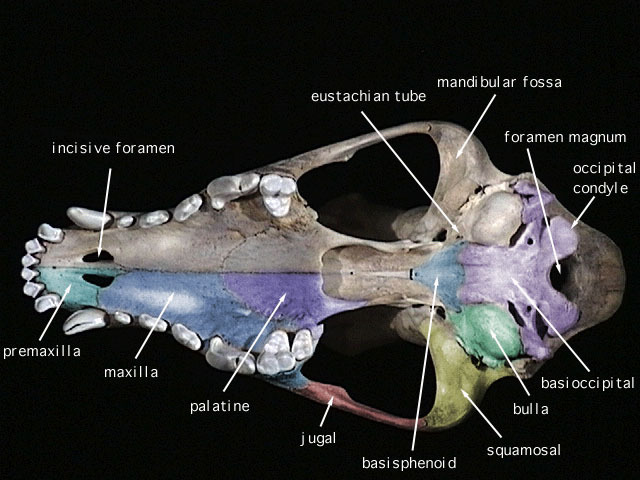
Arvicolines have stomachs that are either one- or two-chambered, and their large intestines
and ceca are extremely complex. However, the small intestine is quite short. There
is no supraorbital branch of the stapedial artery; instead, the infraorbital branch
supplies blood to the orbits. Arvicolines have a diploid chromosome number between
18 and 62.
- Other Physical Features
- endothermic
- homoiothermic
- bilateral symmetry
- polymorphic
Reproduction
Most arvicolines are promiscuous, with males and females both having multiple mates.
In some species, a copulatory plug forms and seals the female's reproductive tract,
preventing subsequent males from successfully fertilizing the female's eggs. However,
a few species, such as
muskrats
and
prairie voles
, live in monogamous pairs and share the responsibility of raising young. In fact,
in captivity it has been shown that prairie voles stay with their parents for more
than one breeding period and help raise their younger siblings (Gruder-Adams and Getz
1985).
- Mating System
- monogamous
- polygynandrous (promiscuous)
- cooperative breeder
Many arvicolines are capable of breeding year round, and some species even give birth
to litters under snow cover. Others concentrate their reproductive efforts during
the warmer months and breed from spring to autumn, with a peak in breeding occurring
from late spring to early summer. In some species, ovulation is not spontaneous;
rather, it is induced by the act of mating. Females are polyestrus, giving birth
to anywhere from 1 to 7 litters per year. They often become impregnated again as
soon as they give birth, due to a postpartum estrus. However, implantation of the
embryo is delayed in some species while the female is lactating. Gestation from the
time the embryo implants is 16 to 30 days. Litter sizes average 3 to 7 young, but
some females have as few as one and as many as 13 young in a litter. The young are
relatively precocial and develop rapidly, opening their eyes at 8 to 16 days and becoming
weaned and independent at 12 to 35 days. Females often breed in the year that they
are born, becoming sexually mature as early as 14 days. Males mature somewhat later
than females.
- Key Reproductive Features
- iteroparous
- seasonal breeding
- year-round breeding
- gonochoric/gonochoristic/dioecious (sexes separate)
- sexual
- induced ovulation
- viviparous
- delayed implantation
- post-partum estrous
Most female arvicolines invest little in each individual offspring, instead employing
a strategy of high reproductive output. They build nests in which they rear their
litters and nurse their relatively precocial young for 12 to 35 days. Often females
become highly aggressive when nursing, fiercely defending their litters against intruding
males. Male parental care occurs in this group, with males of some species brooding
the young in the nest or retrieving them when they wander away. Also, care of youngsters
by older siblings has been reported for arvicolines kept in captivity (Gruder-Adams
and Getz 1985).
- Parental Investment
- precocial
-
pre-fertilization
- provisioning
-
protecting
- female
-
pre-hatching/birth
-
provisioning
- female
-
protecting
- female
-
provisioning
-
pre-weaning/fledging
-
provisioning
- female
-
protecting
- male
- female
-
provisioning
-
pre-independence
-
provisioning
- female
-
protecting
- male
- female
-
provisioning
Lifespan/Longevity
Most arvicolines only live for a few months in the wild. Captivity often extends
the life span by several years.
Behavior
Arvicolines, as a group, display a wide range of lifestyles. Some are terrestrial, some are semi or fully aquatic, some are arborial, and some are fossorial. They are adapted for cursorial or natatorial locomotion. Most are active at any time of the day or night, some are strictly nocturnal, and a few are diurnal. They are active throughout the year. Arvicolines build nests in underground burrows, depressions in the ground, tree holes, tree branches, or under rocks or logs. Some maintain complex tunnel systems underground, through the grass, or under the snow. Underground tunnel systems often have multiple entrances and consist of a nest chamber and adjacent chambers for food storage and defecation.
Arvicolines range in social habits from solitary, aggressive, and territorial to gregarious
and colonial. In some species, population densities become extremely high in certain
years, prompting mass migrations. These population increases are often cyclical in
nature, occuring at regular intervals.
Communication and Perception
Arvicolines are able to perceive tactile, visual, auditory, and chemical signals.
Chemical signals are especially important for communication. Males, and sometimes
females, mark their territories with secretions from their sebaceous flank glands.
Also, some arvicolines are highly vocal and make a variety of chirping and chattering
noises when disturbed or when engaged in a conflict with a conspecific.
- Other Communication Modes
- scent marks
Food Habits
Arvicolines are primarily herbivorous, though some species are omnivorous. They consume
leaves, grasses, forbs, roots, bulbs, bark, twigs, stems, pine needles, berries,
nuts, seeds, lichen, fungi,
insects
,
crayfish
,
mussels
, and small
fish
. Some species cache food in their nests or burrows for use during times of shortage.
- Primary Diet
-
carnivore
- piscivore
- insectivore
- eats non-insect arthropods
- molluscivore
- herbivore
- omnivore
- mycophage
- Foraging Behavior
- stores or caches food
Predation
Hawks
,
owls
,
snakes
, and small mammalian
carnivores
are the main predators of arvicolines. Arvicolines can be quite vicious, gnashing
their teeth and biting when threatened. Also, their neutral-colored fur probably
keeps them somewhat camouflaged.
- Anti-predator Adaptations
- cryptic
Ecosystem Roles
Arvicolines are primary and secondary consumers, and they provide a staple food source
for many other species. The fossorial species turn over earth when they dig, and
therefore may help to aerate the soil. Arvicolines are important for seed dispersal,
and they impact forest regeneration by preying on tree seedlings (Manson et al. 2001).
Because of their important role in forest dynamics, some are considered keystone species.
Finally, because of their high reproductive output and cyclical boom and bust cycles
in population numbers, the population dynamics of arvicolines often influences heavily
the population dynamics of predators such as
snowy owls
and
Canada lynx
, and plant community composition through their grazing activity.
- Ecosystem Impact
- disperses seeds
- soil aeration
- keystone species
Economic Importance for Humans: Positive
Some arvicolines eat large quantities of insect larvae and therefore act as important
controls on pest species. Others are hunted for their pelts or for food.
- Positive Impacts
- food
- body parts are source of valuable material
- controls pest population
Economic Importance for Humans: Negative
Some arvicolines carry diseases such as tularemia. Those that dwell in agricultural
areas sometimes damage crops.
- Negative Impacts
-
injures humans
- carries human disease
- crop pest
Conservation Status
In the subfamily Arvicolinae, the IUCN lists 23 lower risk species, 1 near threatened
species (wood lemming,
Myopus schisticolor
), 4 vulnerable species (Central Kashmir vole,
Alticola montosa
, Mexican vole,
Microtus mexicanus
, Taiwan vole,
Volemys kikuchii
, and Japanese red-backed vole,
Phaulomys andersoni
), 2 endangered species (Alai mole vole,
Ellobius alaicus
and Baluchistan vole,
Microtus kermanensis
), 3 critically endangered species (Wrangel lemming,
Dicrostonyx vinogradovi
, Evorsk vole,
Microtus evoronensis
, and Muisk vole,
Microtus mujanensis
), and 7 species lacking sufficient data to be ranked. Many arvicolines have restricted
ranges, rendering them vulnerable to habitat loss.
Other Comments
The earliest undisputed arvicoline fossils are from the early Pliocene of northwest
Asia, Europe, and North America. It is thought that arvicolines spread into southern
Asia in the late Pliocene.
Additional Links
Contributors
Tanya Dewey (editor), Animal Diversity Web.
Allison Poor (author), University of Michigan-Ann Arbor.
- Nearctic
-
living in the Nearctic biogeographic province, the northern part of the New World. This includes Greenland, the Canadian Arctic islands, and all of the North American as far south as the highlands of central Mexico.

- native range
-
the area in which the animal is naturally found, the region in which it is endemic.
- Palearctic
-
living in the northern part of the Old World. In otherwords, Europe and Asia and northern Africa.
- native range
-
the area in which the animal is naturally found, the region in which it is endemic.
- oriental
-
found in the oriental region of the world. In other words, India and southeast Asia.
- native range
-
the area in which the animal is naturally found, the region in which it is endemic.
- Neotropical
-
living in the southern part of the New World. In other words, Central and South America.
- native range
-
the area in which the animal is naturally found, the region in which it is endemic.
- holarctic
-
a distribution that more or less circles the Arctic, so occurring in both the Nearctic and Palearctic biogeographic regions.
Found in northern North America and northern Europe or Asia.
- temperate
-
that region of the Earth between 23.5 degrees North and 60 degrees North (between the Tropic of Cancer and the Arctic Circle) and between 23.5 degrees South and 60 degrees South (between the Tropic of Capricorn and the Antarctic Circle).
- tropical
-
the region of the earth that surrounds the equator, from 23.5 degrees north to 23.5 degrees south.
- polar
-
the regions of the earth that surround the north and south poles, from the north pole to 60 degrees north and from the south pole to 60 degrees south.
- terrestrial
-
Living on the ground.
- tundra
-
A terrestrial biome with low, shrubby or mat-like vegetation found at extremely high latitudes or elevations, near the limit of plant growth. Soils usually subject to permafrost. Plant diversity is typically low and the growing season is short.
- taiga
-
Coniferous or boreal forest, located in a band across northern North America, Europe, and Asia. This terrestrial biome also occurs at high elevations. Long, cold winters and short, wet summers. Few species of trees are present; these are primarily conifers that grow in dense stands with little undergrowth. Some deciduous trees also may be present.
- tropical savanna and grassland
-
A terrestrial biome. Savannas are grasslands with scattered individual trees that do not form a closed canopy. Extensive savannas are found in parts of subtropical and tropical Africa and South America, and in Australia.
- savanna
-
A grassland with scattered trees or scattered clumps of trees, a type of community intermediate between grassland and forest. See also Tropical savanna and grassland biome.
- temperate grassland
-
A terrestrial biome found in temperate latitudes (>23.5° N or S latitude). Vegetation is made up mostly of grasses, the height and species diversity of which depend largely on the amount of moisture available. Fire and grazing are important in the long-term maintenance of grasslands.
- chaparral
-
Found in coastal areas between 30 and 40 degrees latitude, in areas with a Mediterranean climate. Vegetation is dominated by stands of dense, spiny shrubs with tough (hard or waxy) evergreen leaves. May be maintained by periodic fire. In South America it includes the scrub ecotone between forest and paramo.
- forest
-
forest biomes are dominated by trees, otherwise forest biomes can vary widely in amount of precipitation and seasonality.
- rainforest
-
rainforests, both temperate and tropical, are dominated by trees often forming a closed canopy with little light reaching the ground. Epiphytes and climbing plants are also abundant. Precipitation is typically not limiting, but may be somewhat seasonal.
- scrub forest
-
scrub forests develop in areas that experience dry seasons.
- mountains
-
This terrestrial biome includes summits of high mountains, either without vegetation or covered by low, tundra-like vegetation.
- marsh
-
marshes are wetland areas often dominated by grasses and reeds.
- swamp
-
a wetland area that may be permanently or intermittently covered in water, often dominated by woody vegetation.
- bog
-
a wetland area rich in accumulated plant material and with acidic soils surrounding a body of open water. Bogs have a flora dominated by sedges, heaths, and sphagnum.
- agricultural
-
living in landscapes dominated by human agriculture.
- endothermic
-
animals that use metabolically generated heat to regulate body temperature independently of ambient temperature. Endothermy is a synapomorphy of the Mammalia, although it may have arisen in a (now extinct) synapsid ancestor; the fossil record does not distinguish these possibilities. Convergent in birds.
- bilateral symmetry
-
having body symmetry such that the animal can be divided in one plane into two mirror-image halves. Animals with bilateral symmetry have dorsal and ventral sides, as well as anterior and posterior ends. Synapomorphy of the Bilateria.
- polymorphic
-
"many forms." A species is polymorphic if its individuals can be divided into two or more easily recognized groups, based on structure, color, or other similar characteristics. The term only applies when the distinct groups can be found in the same area; graded or clinal variation throughout the range of a species (e.g. a north-to-south decrease in size) is not polymorphism. Polymorphic characteristics may be inherited because the differences have a genetic basis, or they may be the result of environmental influences. We do not consider sexual differences (i.e. sexual dimorphism), seasonal changes (e.g. change in fur color), or age-related changes to be polymorphic. Polymorphism in a local population can be an adaptation to prevent density-dependent predation, where predators preferentially prey on the most common morph.
- monogamous
-
Having one mate at a time.
- polygynandrous
-
the kind of polygamy in which a female pairs with several males, each of which also pairs with several different females.
- cooperative breeder
-
helpers provide assistance in raising young that are not their own
- iteroparous
-
offspring are produced in more than one group (litters, clutches, etc.) and across multiple seasons (or other periods hospitable to reproduction). Iteroparous animals must, by definition, survive over multiple seasons (or periodic condition changes).
- seasonal breeding
-
breeding is confined to a particular season
- year-round breeding
-
breeding takes place throughout the year
- sexual
-
reproduction that includes combining the genetic contribution of two individuals, a male and a female
- induced ovulation
-
ovulation is stimulated by the act of copulation (does not occur spontaneously)
- viviparous
-
reproduction in which fertilization and development take place within the female body and the developing embryo derives nourishment from the female.
- delayed implantation
-
in mammals, a condition in which a fertilized egg reaches the uterus but delays its implantation in the uterine lining, sometimes for several months.
- young precocial
-
young are relatively well-developed when born
- arboreal
-
Referring to an animal that lives in trees; tree-climbing.
- fossorial
-
Referring to a burrowing life-style or behavior, specialized for digging or burrowing.
- natatorial
-
specialized for swimming
- diurnal
-
- active during the day, 2. lasting for one day.
- nocturnal
-
active during the night
- motile
-
having the capacity to move from one place to another.
- migratory
-
makes seasonal movements between breeding and wintering grounds
- sedentary
-
remains in the same area
- solitary
-
lives alone
- territorial
-
defends an area within the home range, occupied by a single animals or group of animals of the same species and held through overt defense, display, or advertisement
- social
-
associates with others of its species; forms social groups.
- colonial
-
used loosely to describe any group of organisms living together or in close proximity to each other - for example nesting shorebirds that live in large colonies. More specifically refers to a group of organisms in which members act as specialized subunits (a continuous, modular society) - as in clonal organisms.
- acoustic
-
uses sound to communicate
- chemical
-
uses smells or other chemicals to communicate
- scent marks
-
communicates by producing scents from special gland(s) and placing them on a surface whether others can smell or taste them
- visual
-
uses sight to communicate
- tactile
-
uses touch to communicate
- acoustic
-
uses sound to communicate
- chemical
-
uses smells or other chemicals to communicate
- stores or caches food
-
places a food item in a special place to be eaten later. Also called "hoarding"
- cryptic
-
having markings, coloration, shapes, or other features that cause an animal to be camouflaged in its natural environment; being difficult to see or otherwise detect.
- soil aeration
-
digs and breaks up soil so air and water can get in
- keystone species
-
a species whose presence or absence strongly affects populations of other species in that area such that the extirpation of the keystone species in an area will result in the ultimate extirpation of many more species in that area (Example: sea otter).
- food
-
A substance that provides both nutrients and energy to a living thing.
- carnivore
-
an animal that mainly eats meat
- piscivore
-
an animal that mainly eats fish
- insectivore
-
An animal that eats mainly insects or spiders.
- molluscivore
-
eats mollusks, members of Phylum Mollusca
- herbivore
-
An animal that eats mainly plants or parts of plants.
- folivore
-
an animal that mainly eats leaves.
- frugivore
-
an animal that mainly eats fruit
- granivore
-
an animal that mainly eats seeds
- omnivore
-
an animal that mainly eats all kinds of things, including plants and animals
- mycophage
-
an animal that mainly eats fungus
References
Carleton, M., G. Musser. 1984. Muroid rodents. Pp. 289-379 in Orders and Families of Recent Mammals of the World . New York: John Wiley and Sons.
Gruder-Adams, S., L. Getz. 1985. Comparison of the mating system and paternal behavior in Microtus ochrogaster and Microtus pennsylvanicus. Journal of Mammalogy , 66(1): 165-167.
IUCN, 2004. "2004 IUCN Red List of Threatened Species" (On-line). Accessed June 22, 2005 at www.redlist.org .
Jansa, S., M. Weksler. 2004. Phylogeny of muroid rodents: relationships within and among major lineages as determined by IRBP gene sequences. Molecular Phylogenetics and Evolution , 31: 256-276.
Manson, R., R. Ostfeld, C. Canham. 2001. Long-term effects of rodent herbivores on tree invasion dynamics along forest-field edges. Ecology , 82(12): 3320-3329.
Michaux, J., A. Reyes, F. Catzeflis. 2001. Evolutionary history of the most speciose mammals: molecular phylogeny of muroid rodents. Molecular Biology and Evolution , 18: 2017-2031.
Musser, G., M. Carleton. 2005. Superfamily Muroidea. Mammal Species of the World . Baltimore and London: The Johns Hopkins University Press.
Nowak, R. 1999. Walker's Mammals of the World, vol. II . Baltimore and London: The Johns Hopkins University Press.
Simpson, G. 1945. The principles of classification and a classification of mammals. Bulletin of the American Museum of Natural History , 85: 1-350.
Steppan, S., R. Adkins, J. Anderson. 2004. Phylogeny and divergence-date estimates of rapid radiations in muroid rodents based on multiple nuclear genes. Systematic Biology , 53(4): 533-553.
Tullberg, T. 1899. Uber das system der nagethiere: eine phylogenetische studie. Nova Acta Regiae Societatis Scientiarum Upsaliensis , 3: 1-514.