
Search in Everything
Showing results in Everything for bats
Information
Chiroptera bats
external, arthropod parasites. Ticks, mites and insects such as true bugs and fleas are known to live and feed on bats. An entire family of flies, Streblidae, has co-evolved with bats. These flies have secondarily lost the ability to fly, living only in the fur of bats. Species that parasitize bats exhibit a range of host-specificity: some are found on one or a few bats, others occur on a wider variety of bat species, and still others can parasitize bats as well as other taxonomic groups. Although many
Hipposideridae leaf-nosed bats, roundleaf bats, and trident bats
Hipposideridae, Old World leaf-nosed bats, is one of eighteen families that make up the order Chiroptera, and consists of nine genera. The largest genus is Hipposideros (roundleaf bats), which consists of 76 species. The remaining genera are Asellia (trident leaf-nosed bats), Anthops (flower-faced bats), Aselliscus (trident bats), Cloeotis (Percival's trident bat), Coelops (tailless leaf-nosed bats), Paracoelops (orange leaf-nosed bat), Rhinonicteris (orange leaf-nosed bat), and Triaenops (trident bats
Vespertilionidae evening bats and vesper bats
including painted bats, Welwitsch's bats, American red bats, and hoary bats, roost in trees, where their distinctive color patterns serve as camouflage. Southeast Asian club-footed bats make their homes in hollowed-out bamboo stalks, while rufous mouse-eared bats, whiskered bats, and banana pipistrelles roost in rolled-up leaves. Most bat biologists agree that family Vespertilionidae is in need of revision. According to Simmons 2005, there are presently six recognized subfamilies, however, other credible
Rhinolophidae horseshoe bats
known to eat bats are owls and other birds of prey, many carnivores, other bats, snakes, and other opportunistic vertebrate scavengers that encounter an injured or juvenile bat. Bats are probably most vulnerable to predators while they roost or as they emerge in the evening to forage. Some predators (e.g., snakes or hawks) may wait near cave entrances at dusk, attacking bats as they emerge. Juvenile bats that cannot fly are also at risk if they fall to the ground and are not quickly retrieved by their
Furipteridae smoky bats and thumbless bats
Taphozous tomb bats
included Saccolaimus as a subgenus, which was then elevated to genus status in 1991 (Chimimba & Kitchener, 1991). Currently, Saccolaimus is recognized as the sister taxon to Taphozous (Uvizl et al., 2019). Taphozous species are medium to large sized bats with a forearm length ranging from 56 mm to 79 mm (Colket & Wilson, 1998; Patterson & Webala, 2012). Body and head length can range from 64 mm to 112 mm, with significant variation depending on species and location (Dengis, 1996; Harrison, 1958). Color
Noctilionidae bulldog bats
Lasiurus borealis red bat
these bats being impaled by barbed wire, . . . entrapped on road surface oil . . ., flying into lighthouses . . ., and radiator grills of automobiles . . ." (Baker, 1983, pg. 123).Red bats avoid predators through the use of camouflage. Red bats play an important ecosystem role as insect consumers. Red bats rarely invade homes. Red bats keep insect populations down. Unfortunately some people view red bats, along with all other bats, as vermin. However, red bats do not negatively affect humans. Red bats are
Mormoopidae ghost-faced bats, moustached bats, and naked-backed bats
Myotis sodalis Indiana bat
accommodate the bats if they find them. Humans also disturb Indiana bats through recreational caving, so many of their hibernation areas are now closed off to humans. Temperate North American bats, including Indiana bats, are now threatened by a fungal disease called “white-nose syndrome.” This disease has devastated eastern North American bat populations at hibernation sites since 2007. The fungus, Geomyces destructans, grows best in cold, humid conditions that are typical of many bat hibernacula. The
Pictures

Otocyon megalotis bat-eared fox
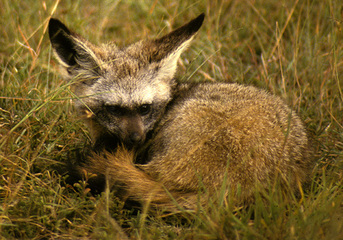
Otocyon megalotis bat-eared fox
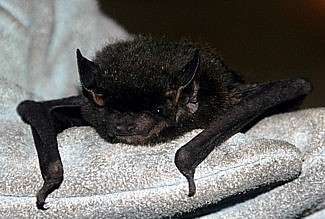
Lasionycteris noctivagans silver-haired bat
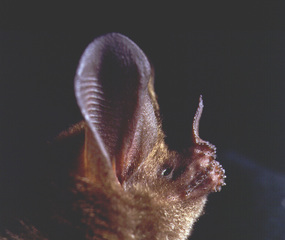
Trachops cirrhosus fringe-lipped bat

Lasiurus cinereus hoary bat
Specimens
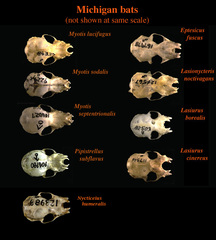
Myotis lucifugus little brown bat
Myotis sodalis Indiana bat
Myotis septentrionalis northern long-eared myotis
Pipistrellus subflavus eastern pipistrelle
Nycticeius humeralis evening bat
Eptesicus fuscus big brown bat
Lasionycteris noctivagans silver-haired bat
Lasiurus borealis red bat
Lasiurus cinereus hoary bat

Myotis lucifugus little brown bat
Myotis sodalis Indiana bat
Myotis septentrionalis northern long-eared myotis
Pipistrellus subflavus eastern pipistrelle
Nycticeius humeralis evening bat
Eptesicus fuscus big brown bat
Lasionycteris noctivagans silver-haired bat
Lasiurus borealis red bat
Lasiurus cinereus hoary bat

Myotis lucifugus little brown bat
Myotis sodalis Indiana bat
Myotis septentrionalis northern long-eared myotis
Pipistrellus subflavus eastern pipistrelle
Nycticeius humeralis evening bat
Eptesicus fuscus big brown bat
Lasionycteris noctivagans silver-haired bat
Lasiurus borealis red bat
Lasiurus cinereus hoary bat

Eptesicus dimissus Surat serotine
chiroptera
Sounds
Topics
Bats are fascinating creatures and important components of ecological communities worldwide. In North America almost all bat species are insectivorous. Although most human cases of rabies in the United States are thought to be the result of interactions with bats, the proportion of any bat population that is infected with rabies is very low. Most people prefer not to live with bats in their homes but an increasing number of people are becoming aware of the benefits of encouraging bats to live nearby. Bats
Identifying Bats The premaxilla The premaxilla is a convenient character for classifying bats. It varies among families in the size of its two components, the palatal and nasal branches, and in whether the nasal branches are fused to each other at the midline, or whether they are fused to the adjacent maxillae. Also, in some cases the palatal branches help define a pair of foramina at the anterior end of the palate; these too may be diagnostic. The difficulty with using the premaxilla, or characteristics of
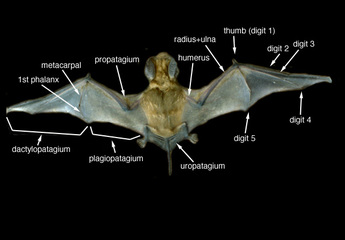
The wings of bats are their most distinctive -- and perhaps most remarkable -- feature. They give the order Chiroptera its name (literally, "hand-wing"), and functional wings and true flight are characteristics of all bats. The origin of bat wings is most clearly revealed by their skeleton. Every element of that skeleton is clearly homologous with structures in the forelimbs of other mammals, and there is no question that bat wings evolved as a result of modifications to the forelimbs of their ancestors
Many bats have noseleaves or other kinds of ornaments on their faces. Noseleaves characterize almost all members of the families Phyllostomidae, Rhinolophidae and Megadermatidae. The exact shape and position of the noseleaf can be an important character for identifying and classifying a bat. The function of noseleaves is believed to be in focusing echolocation calls as they are emitted (these bats call through their noses). Other facial structures, such as the swellings often seen on the snout of
Class: Order: Family: Genus: Species: D. Are Zebras: SOLITARY or SOCIAL. #10. Of the mammals classified above, _________ and _________ are most closely related. EXTRA CREDIT #11. Click on "Mammalia" - then find "Special Topics Contents" and click on that. Then click on "wings" of bats. Do bats have a thumb
Classification
Myonycteris brachycephala Sao Tomé collared fruit bat
Scoteanax rueppellii Rüppell's broad-nosed bat
Acerodon fruit bats
Acerodon celebensis Sulawesi fruit bat
Acerodon humilis Talaud fruit bat
Acerodon jubatus golden-capped fruit bat
Acerodon leucotis Palawan fruit bat
Acerodon lucifer Panay golden-capped fruit bat
Acerodon mackloti Sunda fruit bat
Rhinolophus fumigatus Rüppell's horseshoe bat
Chaerephon tomensis São Tomé free-tailed bat