Dioctophyma renale
Geographic Range
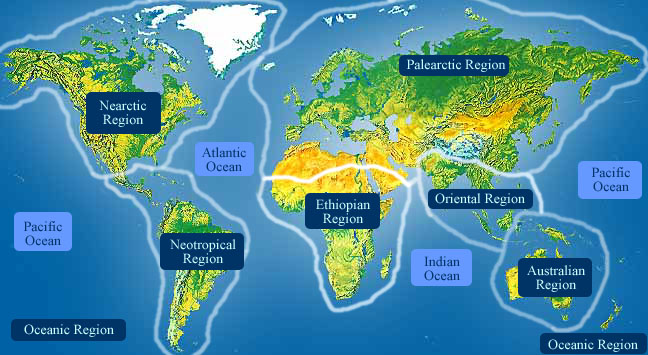
Dioctophyma renale is a cosmopolitan parasite occuring across Europe, the Americas, Africa and Australia. (Moravec, 1994)
- Biogeographic Regions
- nearctic
- palearctic
- ethiopian
- neotropical
- australian
Habitat
Dioctophyma renale has a wide range of mammalian host species, such as dog, wolf, cheetah, mink, horse, swine and humans. Fish-eating mammals are the most common hosts of D. renale because fish often serve as paratenic hosts after ingesting an infected annelid intermediate. Any mammal that drinks water infested with infected annelid intermediate hosts, such as horses, has the potential of ingesting an infective third stage juvenile of D. renale. Given the aquatic portion of its life cycle, water is a necessary element of the habitat of D. renale. (Kothekar, 1984)
- Habitat Regions
- temperate
- tropical
- terrestrial
- freshwater
- Terrestrial Biomes
- desert or dune
- savanna or grassland
- chaparral
- forest
- rainforest
- scrub forest
- Aquatic Biomes
- lakes and ponds
- temporary pools
- Other Habitat Features
- urban
- suburban
- agricultural
Physical Description
Dioctophyma renale is one of the largest nematodes to parasitize humans. This worm is cylindrical, has a cuticle with three or more main outer layers made of collagen and other compounds. The outer layers are non-cellular and are secreted by the epidermis. The cuticle layer protects the nematodes so they can invade the digestive tracts of animals. Longitudinal muscles line the body wall. The muscles are obliquely arranged in bands. Dorsal, ventral and longitudinal nerve cords are connected to the main body of the muscle.

Adult females are significantly larger than males, reaching up to 100 cm long and 12 mm wide whereas males only reach 20 cm long and 6 mm wide. Dioctophyma renale is generally red in color and blunt at the end. The male has a fleshy bell-shaped copulatory organ, or bursa, without any supporting rays and a single bristle-like spicule. The female reproductive organ, or vulva, is in the anterior of the body. The eggs are constant in size, light in color, lemon-shaped with deep pits in the shells. The larvae of D. renale are yellow to rusty colored, threadlike and range in length from 6.0 to 10 mm and in width from .1 mm to .202 mm. (Moravec, 1994; Olsen, 1974; Roberts and Janvoy, 1996; Tuur, et al., 1987)
- Other Physical Features
- ectothermic
- heterothermic
- bilateral symmetry
- Sexual Dimorphism
- female larger
- sexes shaped differently
-
- Range length
- 20 to 100 cm
- 7.87 to 39.37 in
Development
Dioctophyma renale eggs are laid in the kidneys of the definitive host and passed to the urinary bladder. They need two weeks to three months in water, depending on temperature, to embryonate. Infective eggs only hatch when ingested by an intermediate host of D. renale, generally an annelid worm. The first stage juveniles penetrate the ventral blood vessel of the annelid host and develop through two molts into the third stage juvenile. When the intermediate host annelid is ingested by a fish, the third stage larvae encysts in the abdominal muscle or wall of the digestive tube and the fish acts as a paratenic host. Third stage juveniles of D. renale continue to mature until the paratenic host is eaten by a vertebrate definitive host, where they migrate from the intestine to the kidney and eventually reach sexual maturity. (Moravec, 1994; Olsen, 1974; Roberts and Janvoy, 1996)
Reproduction
Females may produce a phermomone to attract males. The male coils around a female with his curved area over the female genital pore. The gubernaculum, made of cuticle tissue, guides spicules which extend through the cloaca and anus. Males use spicules to hold the female during copulation. Nematode sperm are amoeboid-like and lack flagella. (Barnes, 1987; Roberts and Janvoy, 1996)

- Key Reproductive Features
- sexual
- fertilization
- oviparous
- Parental Investment
-
pre-fertilization
- provisioning
Behavior
Often the right kidney is infected, perhaps because it is closer to the stomach and liver. (Roberts and Janvoy, 1996)
Communication and Perception
Nematodes in general have papillae, setae and amphids as the main sense organs. Setae detect motion (mechanoreceptors), while amphids detect chemicals (chemoreceptors). (Barnes, 1987; Roberts and Janvoy, 1996)

- Other Communication Modes
- pheromones
Food Habits
Dioctophyma renale is most prevalently found in the kidneys and parts of the abdominal cavities of mammalian hosts. Rarely, D. renale is found in the ureter, urinary bladder or urinary canal. Dioctophyma renale generally feed on blood and tissue cells. Pharyngeal glands and intestinal epithelium produce digestive enzymes to feed on the hosts’ body fluids. Extracellular digestion begins within the lumen and is finished intracellularly. (Barnes, 1987; Kothekar, 1984; Roberts and Janvoy, 1996)
- Primary Diet
-
carnivore
- sanguivore
- eats body fluids
- Animal Foods
- blood
- body fluids
Predation
These parasites are usually not preyed on directly, but are ingested from host to host. Larval mortality is high as most of the parasites do not reach appropriate hosts.
Ecosystem Roles
Dioctophyma renale has a wide range of mammalian host species, such as dog, wolf, cheetah, mink, horse, swine and humans. Fish-eating mammals are the most common hosts of D. renale because fish often serve as paratenic hosts after ingesting an infected annelid intermediate. Any mammal that drinks water infested with infected annelid intermediate hosts, such as horses, has the potential of ingesting an infective third stage juvenile of D. renale. (Kothekar, 1984)
- Ecosystem Impact
- parasite
- horses, Equus
- dogs and wolves, Canis
- swine, Suidae
- mink, Mustela
- cheetah, Acinonyx jubatus
- humans, Homo sapiens
- Annelida
Economic Importance for Humans: Negative
Dioctophyma renale can have devastating effects on its host. In one study, the presence of D. renale in dogs, ranging in size from 21 x .3 cm to 75.5 x .8 cm, caused macroscopic alterations in the kidneys as well as in the abdominal cavities. Most hosts of D. renale, including humans, suffer from pressure necrosis caused by growing worms and their feeding activities. This reduces the infected kidney to a thin-walled, ineffective organ. Loss of kidney function and uremic poisoning are severe side effects. Treatment is limited to surgical removal of the parasite and the affected kidney. Human infection with D. renale is rare and generally easy to avoid via thorough cooking of fish and boiling of water. (Neves, et al., 1983; Roberts and Janvoy, 1996)
- Negative Impacts
- injures humans
- causes or carries domestic animal disease
Contributors
Renee Sherman Mulcrone (editor).
Maya Ravani (author), University of Michigan-Ann Arbor, Solomon David (editor), University of Michigan-Ann Arbor.
Glossary
- Australian
-
Living in Australia, New Zealand, Tasmania, New Guinea and associated islands.
- Ethiopian
-
living in sub-Saharan Africa (south of 30 degrees north) and Madagascar.
- Nearctic
-
living in the Nearctic biogeographic province, the northern part of the New World. This includes Greenland, the Canadian Arctic islands, and all of the North American as far south as the highlands of central Mexico.
- Neotropical
-
living in the southern part of the New World. In other words, Central and South America.
- Palearctic
-
living in the northern part of the Old World. In otherwords, Europe and Asia and northern Africa.
- agricultural
-
living in landscapes dominated by human agriculture.
- bilateral symmetry
-
having body symmetry such that the animal can be divided in one plane into two mirror-image halves. Animals with bilateral symmetry have dorsal and ventral sides, as well as anterior and posterior ends. Synapomorphy of the Bilateria.
- carnivore
-
an animal that mainly eats meat
- causes disease in humans
-
an animal which directly causes disease in humans. For example, diseases caused by infection of filarial nematodes (elephantiasis and river blindness).
- causes or carries domestic animal disease
-
either directly causes, or indirectly transmits, a disease to a domestic animal
- chaparral
-
Found in coastal areas between 30 and 40 degrees latitude, in areas with a Mediterranean climate. Vegetation is dominated by stands of dense, spiny shrubs with tough (hard or waxy) evergreen leaves. May be maintained by periodic fire. In South America it includes the scrub ecotone between forest and paramo.
- chemical
-
uses smells or other chemicals to communicate
- desert or dunes
-
in deserts low (less than 30 cm per year) and unpredictable rainfall results in landscapes dominated by plants and animals adapted to aridity. Vegetation is typically sparse, though spectacular blooms may occur following rain. Deserts can be cold or warm and daily temperates typically fluctuate. In dune areas vegetation is also sparse and conditions are dry. This is because sand does not hold water well so little is available to plants. In dunes near seas and oceans this is compounded by the influence of salt in the air and soil. Salt limits the ability of plants to take up water through their roots.
- ectothermic
-
animals which must use heat acquired from the environment and behavioral adaptations to regulate body temperature
- fertilization
-
union of egg and spermatozoan
- forest
-
forest biomes are dominated by trees, otherwise forest biomes can vary widely in amount of precipitation and seasonality.
- freshwater
-
mainly lives in water that is not salty.
- heterothermic
-
having a body temperature that fluctuates with that of the immediate environment; having no mechanism or a poorly developed mechanism for regulating internal body temperature.
- internal fertilization
-
fertilization takes place within the female's body
- marsh
-
marshes are wetland areas often dominated by grasses and reeds.
- motile
-
having the capacity to move from one place to another.
- oviparous
-
reproduction in which eggs are released by the female; development of offspring occurs outside the mother's body.
- parasite
-
an organism that obtains nutrients from other organisms in a harmful way that doesn't cause immediate death
- pheromones
-
chemicals released into air or water that are detected by and responded to by other animals of the same species
- rainforest
-
rainforests, both temperate and tropical, are dominated by trees often forming a closed canopy with little light reaching the ground. Epiphytes and climbing plants are also abundant. Precipitation is typically not limiting, but may be somewhat seasonal.
- sanguivore
-
an animal that mainly eats blood
- scrub forest
-
scrub forests develop in areas that experience dry seasons.
- sedentary
-
remains in the same area
- sexual
-
reproduction that includes combining the genetic contribution of two individuals, a male and a female
- suburban
-
living in residential areas on the outskirts of large cities or towns.
- swamp
-
a wetland area that may be permanently or intermittently covered in water, often dominated by woody vegetation.
- tactile
-
uses touch to communicate
- temperate
-
that region of the Earth between 23.5 degrees North and 60 degrees North (between the Tropic of Cancer and the Arctic Circle) and between 23.5 degrees South and 60 degrees South (between the Tropic of Capricorn and the Antarctic Circle).
- terrestrial
-
Living on the ground.
- tropical
-
the region of the earth that surrounds the equator, from 23.5 degrees north to 23.5 degrees south.
- tropical savanna and grassland
-
A terrestrial biome. Savannas are grasslands with scattered individual trees that do not form a closed canopy. Extensive savannas are found in parts of subtropical and tropical Africa and South America, and in Australia.
- savanna
-
A grassland with scattered trees or scattered clumps of trees, a type of community intermediate between grassland and forest. See also Tropical savanna and grassland biome.
- temperate grassland
-
A terrestrial biome found in temperate latitudes (>23.5° N or S latitude). Vegetation is made up mostly of grasses, the height and species diversity of which depend largely on the amount of moisture available. Fire and grazing are important in the long-term maintenance of grasslands.
- urban
-
living in cities and large towns, landscapes dominated by human structures and activity.
References
Barnes, R. 1987. Invertebrate Zoology. Orlando, Florida: Dryden Press.
Kothekar, V. 1984. Key to Parasitic Nematodes V 4. Washington, D.C.: Amerind Publishing Co., Pvt, Ltd..
Moravec, F. 1994. Parasitic Nematodes of Freshwater Fishes of Europe. The Netherlands: Kluwer Academic Publishers.
Neves, D., A. Morais, R. Nogueira, M. Chquiloff. 1983. Occurrence of Dioctophyma renale in Dogs in Lages State of Santa-Catarina Brazil. Arquivo Brasileiro de Medicina Veterinaria e Zootecnia, 35 (5): 665-674.
Ohio State University, 2001?. "Dioctophyme renale (giant kidney worm)" (On-line). Parasites and Parasitological Resources. Accessed September 15, 2004 at http://www.biosci.ohio-state.edu/~parasite/dioctophyme.html.
Olsen, O. 1974. Animal Parasites: Their Life Cycles and Ecology Third Edition. Maryland: University Park Press.
Roberts, L., J. Janvoy. 1996. Foundations of Parasitology Sixth Edition. Massachusetts: The McGraw-Hill Companies, Inc..
Tuur, S., A. Nelson, D. Gibson, F. Johnson, F. Mostofi. 1987. Liesegange Rings in Tissue: How to Distinguish Liesegang Rings from the Giant Kidney Worm Dioctophyme renale. American Journal of Surgical Pathology, 11 (8): 598-605.