
Search in Everything
Showing results in Everything for carnivore
Information
Carnivora carnivores
Members of the mammalian order Carnivora are the descendants of a successful late Paleocene radiation of mammals whose primitive food habits were carnivorous. The name "Carnivora" is sometimes taken to mean that members of this group are all carnivorous or that all carnivorous mammals are members of this group. This is not so. Members of Carnivora have diverse food habits, although many are primarily carnivorous, and carnivory is widely distributed in mammals, being found in many other orders including bats
Eupleridae Malagasy carnivores
The family Eupleridae, the Malagasy carnivores, consists of eight species and seven genera in two subfamilies. The diversity of form and function in this family is such that some have suggested it be split into several families. Species in the family Eupleridae are restricted to the island of Madagascar. Euplerids live in a variety of habitats, from humid forests, marshes, bogs, and swamps, to deserts and savannahs. Aside from molecular synapomorphies, euplerids have few traits in common. They tend to have
Dasyuromorphia dasyuroid marsupials and marsupial carnivores
Dasyuromorphia.The early radiation of Dasyuromorphia was comprised mostly of “primitive” thylacinids,ranging in size from that of a small dog to approximately 65 pounds. Thylacinids were dominant carnivores throughout Australia, New Guinea, and Tasmania until the Miocene, when the population began to decline, likely because of competition from other large carnivorous marsupials. Only one species survived to modernity: the Tasmanian wolf. Disappearance of this species from the mainland of Australia and
Genetta genetta common genet; small-spotted genet
ancestor of the carnivores. Although the genets are very catlike, they also display some primitive features of this ancestor, making them an interesting study for people interested in carnivore evolution. It is suggested that others interested in this topic also research the civets, palm civets and linsangs for more information on viverrids
Alaska-California low intertidal-shallow sublittoral rocky coast dioecious and oviparous. These anemones are solitary, lack a medusa stage, and are sessile. This species is carnivorous, using nematocysts to paralize prey. They feed on relatively large organisms. Neptunea pribiloffenses, a snail, lay eggs by Tealia crassicornis because the anemones eat sea urchins that prey on the snails' eggs
Linguatula serrata tongueworm
the definitive, carnivorous host feeds upon the intermediate host when the larvae are in their third stage, the carnivore acquires the parasite. The larvae develop to their adult stage in the nasopharynx of the carnivorous mammals and mate. Although sexually dimorphic, larger females attempt to find similarly sized males to mate. Linguatula serrata females mate once over the course of their lifetime, but due to huge spermathecal storage and oocytes continuously being ejected from the ovary, females can lay
Mustelidae badgers, otters, weasels, and relatives
terrestrial, aquatic, and arboreal habitats. Some species regularly prey on animals larger than themselves. Some species have been known to store food (e.g., Mustela, Gulo). Mustelids are generally small carnivores, and are therefore subject to predation by larger carnivores such as canids with which they co-occur. They may also fall prey to large snakes (Serpentes), raptors (Falconiformes), and owls (Strigiformes). Some mustelids secrete noxious chemicals to discourage predators. In some of these species
Genetta aquatic genet; genets
Genetta refers to a grouping of 17 species of mammals known as genets within the family Viverridae, which primarily consists of genets and civets. Each species within Genetta is classified as a carnivore and almost exclusively inhabits the African continent in a variety of habitats that range from the forests to the savanna. The most widely studied genet--Genetta genetta, or "common genet",-- has been known to inhabit parts of Europe and Western Asia (Roberts et al., 2007). Genets can be identified by their
Bassaricyon gabbii olingo
altricial, and like most carnivores, are born with their eyes closed. Birth weight is around 55 g. By about 27 days of age, the eyes of the young have opened. Solid food may be consumed as young as 2 months of age. By 21 to 24 months of age, B. gabbii has reached sexual maturity. Male parental care has not been reported for these animals. Females, like females of other mammalian species, take care of infants, providing them with milk, grooming, and protection. Young begin to consume solid food by about 2
Arctogalidia trivirgata small-toothed palm civet
perception of small-toothed palm civets. However, females have perineal scent glands that are used for chemical signaling during mating and breeding periods. While listed as a carnivore and known to prey on a wide range of small mammals, small-toothed palm civets are often seen eating an array of fruits. Due to the development and arrangement of their teeth it is assumed that fruit is the most important item in their diet. The rows of teeth for this species are unique to the carnivore order. The first and
Pictures

Haplotrema concavum

Canis latrans coyote

Paracirrhites arcatus Arc eye; Whiteline hawkfish

Galidia elegans ring-tailed mongoose

Cryptoprocta ferox fossa
Specimens
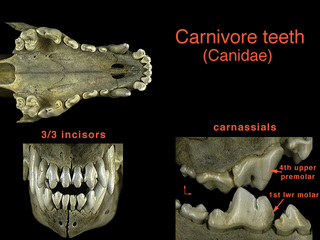
Canis lupus gray wolf

Actinopterygii ray-finned fishes

Galidia elegans ring-tailed mongoose

Galidia elegans ring-tailed mongoose
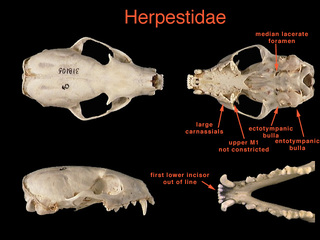
Galidia elegans ring-tailed mongoose
Sounds
Topics
insectivores is _____________ #5. Click on "Back" or "Mammalia" - then click on "Lagomorpha". A. These animals are: TERRESTRIAL or AQUATIC B. Click on family "Leporidae", then click on "eastern cottontail". The classification of the eastern cottontail is: Kingdom: Phylum: Class: Order: Family: Genus: Species: C. Are rabbits: CARNIVOROUS or HERBIVOROUS D. How do rabbits benefit humans? ___________________________________________ #6. Click on "Mammalia" - then click on
well-developed crests (lophs). An opposite extreme is seen, for example, in some mustelid carnivores. The glenoid fossa of wolverines has anterior and posterior lips that lock around the articular process of the lower jaw, such that in some specimens the two parts of the skull cannot be separated. These animals are mostly restricted to an up-and-down chewing motion, useful for shearing meat and crushing bones. Different styles of chewing require very different arrangements of the muscles that control jaw
diagnose; includes forms that are strictly arboreal, others that are scansorial or terrestrial, some that are largely aquatic, and a few that are fossorial. Molar morphology is highly complex and variable. Food habits range from primarily herbivorous to primarily insectivorous; a few species are at least partly carnivorous; some consume large amounts of fungus. Includes such familiar genera as Peromyscus, Neotoma, Oryzomys. The number of species may be greatly underestimated. Cricetinae (18 species, 7
Differentiation of teeth in an individual
the shovel-like lower incisors of hippos, and the lateral (third) incisors of some carnivores, such as bears, which resemble small stabbing canine teeth. Canines -- All mammals have a single canine in each quadrant, if they have canines at all. These teeth are often absent; they are never found in modern rodents, for example, and many artiodactyls have them only in the lower jaw. When present, the canines are the first tooth in the maxilla. They tend to be moderately to very long, and most commonly they
some marsupials, both the first and second digits are opposable, creating a powerful grip for round surfaces; this adaptation is known as schizodactly. (Cartmill, 1985) Hand proportions: Climbing mammals often possess different hand proportions than their terrestrial counterparts. The palm (metacarpals) is often shortened and the fingers (proximal and/or intermediate phalanges) are often elongated in scansorial and arboreal species. Such a pattern has been found in carnivores, rodents, marsupials, and
Legs, Feet, and Cursorial Locomotion
species walk on their tiptoes, often on hooves. Deer and horses are examples. A second way of increasing stride length, often found in unguligrade species, is to lengthen limb elements. A common way to do this, found in several groups, is elongation of the metapodials. This is often coupled with a reduction in number of these bones. Cursorial carnivores such as canids and cheetahs have metapodials that are very long compared to their digits, and the first metapodial (and digit) is reduced or lost. The
Classification
Caniformia caniform carnivores
Carnivora carnivores
Dasyuromorphia dasyuroid marsupials and marsupial carnivores
Eupleridae Malagasy carnivores
Feliformia feliform carnivores
Haemaphysalis indica Indian small carnivore haemaphysalid